Index
Modern physics has achieved extraordinary predictive power, yet it remains structurally divided. Quantum Mechanics (QM) governs the microscopic domain through probability, superposition, and non-local correlations, while General Relativity (GR) describes the macroscopic universe through geometry, causality, and deterministic evolution. Despite their individual successes, these frameworks remain conceptually incompatible at their foundations.
The Physics of Coherence (PoC) is proposed as a unifying theoretical framework that does not attempt to quantize gravity nor classicalize quantum mechanics, but instead identifies a deeper, pre-physical layer from which both emerge naturally.
PoC is based on a central premise: Reality is not primarily constructed from space, time, energy, or fields, but from coherence.
Fig.1 PoC coherence pipeline. This diagram illustrates the logical structure of manifestation in PoC, from quantum coherence (COH) to Relativistic Space (RS). The pipeline does not represent a temporal sequence, but a coherence-based hierarchy. Discretization occurs only at the COFT level, once compatibility conditions (Qi) are satisfied, enabling the emergence of C-Discrete and C-Ordinary regimes within RS.
Across contemporary physics, several unresolved tensions persist:
PoC does not introduce new particles, forces, or speculative dimensions. Instead, it reframes the problem by identifying coherence as the fundamental organizing principle from which physical observables arise.
In the PoC framework:
Quantum phenomena and relativistic geometry are interpreted as two complementary regimes of manifestation of a deeper coherent substrate. This substrate is not observable, not energetic, and not spatial. It does not transmit information, propagate signals, or evolve in time.
It simply is.
Coherence in PoC is not equivalent to quantum coherence as defined in standard QM. It is a broader ontological principle characterized by:
From this perspective:
PoC introduces a clear conceptual separation between two regimes:
The transition between QS and RS is not causal, energetic, or signal-based.
It is mediated through coherent thresholds, governed by intervallic compatibility rather than force.
This duality does not imply separation, but continuous coherence coupling.
Without a coherence-based framework:
PoC provides a minimal yet powerful foundation from which these phenomena can be reinterpreted without violating existing empirical results.
It does not replace current physics.It reorganizes its foundations.
Physics of Coherence is intended as:
Its purpose is not to finalize physics, but to restore conceptual continuity across its domains.
The sections that follow develop PoC progressively:
Each block is designed to be internally consistent, minimal in assumptions, and compatible with existing physical knowledge. PoC proposes that the universe is not governed by laws imposed on matter, but by coherence that allows matter to exist at all.
At the foundation of Physics of Coherence lies a concept both simple and radical: coherence is not a property of physical systems — it is the condition that allows physical systems to exist at all.
In conventional physics, coherence is treated as a secondary phenomenon: a fragile alignment of phases in quantum systems, easily destroyed by interaction, noise, or measurement. In PoC, this view is inverted.
Coherence is primary.Matter, space, time, energy, and fields are secondary manifestations.
In Quantum Mechanics, coherence refers to the phase relationship between components of a wavefunction. While useful, this definition is incomplete. It describes how systems behave once they exist, not why they can exist coherently in the first place.
Physics of Coherence extends the concept:
Coherence is the precondition of consistency across all physical regimes.
In PoC, coherence is defined as:
The atemporal, non-local, non-energetic condition that enables structured possibility and stable manifestation.
This means:
It permits.
All observable phenomena — particles, waves, forces, spacetime geometry — are expressions of how coherence becomes resolved under specific constraints.
Importantly, coherence does not imply order in the classical sense.
PoC distinguishes between:
Coherence allows both apparent order and apparent randomness to emerge without contradiction.
This is why quantum indeterminacy and relativistic determinism can coexist: they are regimes, not absolutes.
A crucial clarification:
Fields (electromagnetic, gravitational, etc.) operate within coherence. They are not its source.
In PoC, what physics traditionally calls “fields” are resolved modes of coherence under relativistic constraints.
Coherence cannot be measured directly because:
Coherence is therefore structurally inaccessible, yet universally active.
It is known only through its consequences.
Once coherence is accepted as fundamental, several long-standing issues become tractable:
Coherence does not answer these questions directly. It reframes them correctly.
Physics of Coherence begins not with equations, but with a shift of foundation:
Reality is coherent first, physical second.
Everything that follows — space, time, matter, gravity — is a consequence of how coherence becomes constrained, resolved, and stabilized
Physics of Coherence proposes a decisive shift in perspective:
coherence is not embedded in the universe — the universe is embedded in coherence.
This section clarifies how coherence functions as the fundamental substrate from which all physical domains arise, without itself belonging to any of them.
Coherence does not reside inside space, time, or energy.
Instead:
Coherence therefore cannot be located, bounded, or quantified using physical coordinates.
It is pre-physical, yet indispensable to all physical description.
Within the PoC framework, reality is described using two complementary domains:
Crucially, these are not separate worlds. They are two regimes of the same coherent substrate, differentiated by how coherence becomes resolved.
QS is not a vacuum, nor a hidden physical layer.
QS is defined as:
The regime where coherence exists without discretization.
In QS:
Yet QS is not “nothing”.
It is full coherence without manifestation.
RS is the domain where coherence becomes constrained by:
RS does not generate coherence. RS filters coherence into stable, observable forms.
Particles, fields, forces, and spacetime geometry are not fundamental objects — they are coherent resolutions.
A central principle of PoC:
Coherence is not transmitted between QS and RS.
It is shared across them.
There is no signal traveling from QS to RS.
No energy exchange. No causal channel.
QS and RS remain synchronized because they are expressions of the same coherent condition.
This eliminates the need for hidden variables, faster-than-light influences, or exotic mediators.
By recognizing coherence as a shared substrate:
The conflict was never physical — it was conceptual.
One of coherence’s most profound roles is stability.
Coherence explains why:
Stability is not enforced by equations — it is inherited from coherence.
QS and RS are not layers stacked atop one another.
They are views of the same coherent reality, seen under different constraints.
Coherence does not belong to the universe. The universe belongs to coherence.
PoC proposes that physical reality is not “everywhere.”
It occupies a coherence-compatible spectral window inside RS.
Outside that window, coherence does not vanish — but matter can no longer form or remain stable.
We call this boundary the Coherence Break:
C-Break — the coherence threshold beyond which RS cannot sustain discrete, stable manifestation.
In standard physics, space exists everywhere, and matter is “allowed” everywhere (even if diluted).
PoC instead proposes:
This makes C-Break a fundamental structural feature of reality — not an artifact.
In PoC, these regimes are denoted as C-Discrete, where coherence can be phase-locked into stable matter, and C-Ordinary, where coherence persists without discrete physical stabilization.
Where coherence can be stabilized into:
This is the visible / baryonic regime.
Where coherence remains present, but cannot be discretized into stable physical forms.
This is the regime of:
This is still RS, but RS operating beyond discrete compatibility.
C-Break is reached when the RS window loses the conditions required for stable discretization.
In PoC language:
C-Break therefore marks the point where:
RS can still exist, but cannot remain “physically readable.”
C-Break is not a wall in space.
It is a coherence condition, meaning it can occur:
So C-Break should be understood as:
a boundary in coherence-resolution, not a boundary in distance.
PoC predicts a relatively narrow interval in which discrete matter is stable:
This yields a central idea:
Matter is not the default.
Matter is the “Goldilocks” outcome of coherence compatibility.
Beyond C-Break is C-Ordinary:
In that region, what we interpret as:
becomes the primary expression of RS.
C-Break is the key that allows PoC to link:
without adding exotic substances as separate realities.
The universe does not become empty. It becomes unreadable in discrete form.
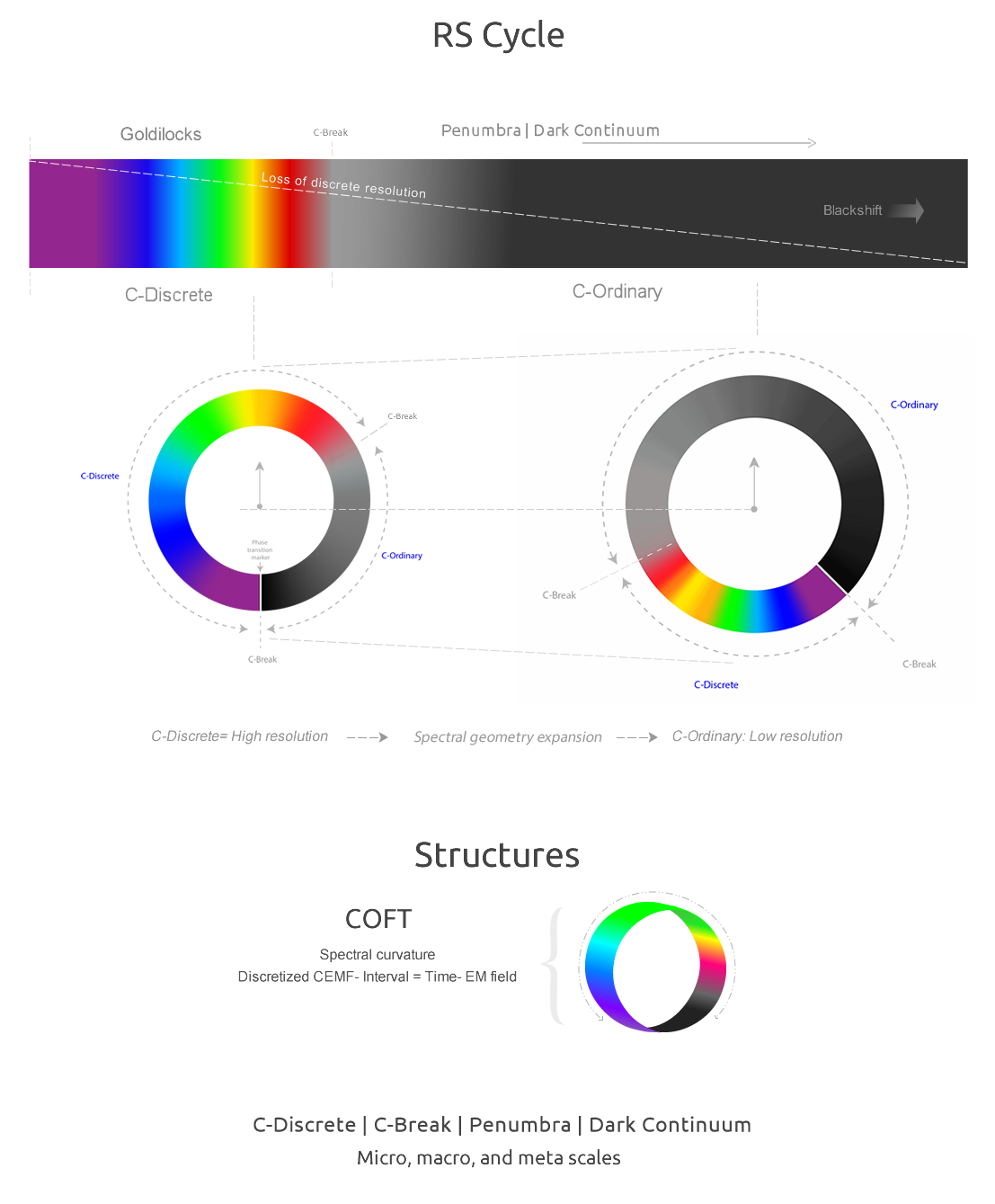
What standard cosmology calls Dark Energy and Dark Matter corresponds, in PoC, to coherence operating beyond discrete compatibility.
In the standard picture, the universe appears to be:
PoC reframes this entirely:
The missing 96% is not missing mass.
It is coherence that no longer resolves into discrete physical form.
This does not imply absence. It implies ordinal dominance.
Within C-Ordinary, PoC identifies two coherence-dominant RS domains.
The Penumbra is the near-C-Break region.
Characteristics:
This domain corresponds naturally to what is observed as:
In PoC terms:
Penumbra is almost matter, but not stably discrete.
Beyond the Penumbra lies the Dark Continuum.
Characteristics:
This domain corresponds to:
Here, RS still exists — but only as coherence flow, not as matter.
A key strength of PoC is that gravity does not disappear beyond discrete matter.
Why?
Because gravity is not mass-caused.
From PoC:
Because gravity is not fundamentally caused by mass alone.
Therefore:
This explains why:
A critical clarification:
Ordinal coherence is not chaos.
It is:
PoC explicitly rejects the idea that “non-particle” means “non-structured.”
Instead:
The C-Ordinary sector is more coherent, not less — just not discretely readable.
Because coherence never collapses, PoC naturally supports:
Even when all stars fade:
This makes PoC inherently non-terminal.
PoC does not add dark components. It reclassifies reality.
What we called “dark” is simply:
coherence operating outside the discrete window.
Matter is not the majority state of the universe. It is the temporary readable phase, but crossing the C-Break does not imply disappearance or annihilation, but a transition between coherence regimes: from C-Discrete to C-Ordinary, or conversely.
In PoC, matter is not a primitive ingredient of reality. It is a special condition.
Matter appears only when coherence satisfies a very strict requirement: phase-locking across the discrete threshold.
Fig.2 Collapse as a compatibility function. In PoC, collapse is not a sudden or destructive event, but a smooth transition governed by coherence compatibility. Discrete manifestation emerges only when compatibility conditions (Qi) are satisfied, allowing phase-locked coherence to stabilize as matter. Below this threshold, coherence remains ordinal and non-discrete.
Traditional physics treats matter as “stuff” that occupies space and evolves in time.
PoC replaces this view entirely:
Matter is coherence temporarily locked into a stable discrete phase.
Nothing is added to the universe when matter forms.
Instead, coherence constrains itself.
From earlier sections:
Matter exists only inside this band.
Phase-locking means:
This produces:
In short:
Matter is coherence that refuses to slide.
Phase-locking is energetically restrictive and structurally fragile.
Most coherence:
Only rare conditions allow:
Hence:
The universe is not made of matter — matter is a temporary articulation of coherence.
In PoC, mass is reinterpreted as:
resistance to phase reconfiguration
A massive object:
This explains why:
Mass is not quantity. It is stability.
Quantum properties arise from how coherence locks, not from intrinsic traits.
Examples:
These are not labels — they are coherence geometries.
This is why:
Matter exists:
Outside this band:
Thus:
Matter is not what the universe is made of.
Matter is what happens when coherence pauses.
A brief arrest.
A phase-locked note.
A readable chord.
And that is why matter is precious — and why it never lasts.
Physics of Coherence (PoC) does not reject mathematics. It reorders its role.
Instead of starting from equations and forcing interpretation, PoC begins with structural relations, from which mathematics emerges naturally.
This section presents the minimal formal scaffold required to make PoC operational, falsifiable, and extensible — without premature over-formalization.
Historically, physics has faced two failures:
PoC avoids both by introducing:
Mathematics as a descriptive language of coherence constraints, not as the generator of reality.
At minimum, PoC requires only four abstract objects:
$\mathcal{C}$
Not a physical field.
A relational substrate from which all structures emerge.
No metric.
No coordinates.
Only relational potential.
$\mathcal{I}$
The operator of transition without time.
$\mathcal{I} : \mathcal{C} \rightarrow \mathcal{C}'$
It enables change without chronology.
$$ \mathcal{T}_c $$
The discretized projection of coherence into the RS. Defined not by clocks, but by resolution bandwidth:
$$ \mathcal{T}_c = \mathrm{Discretize}(\mathcal{I}, c) $$
Where:
$$\psi_d \subset \mathcal{T}_c$$
Discrete, stable coherence configurations that:
In PoC:
Instead:
Metrics emerge after coherence differentiates.
PoC does not begin with equations of motion.
Instead, it defines regimes:
Transitions between regimes are governed by compatibility constraints, not forces.
A system changes state when:
$$\Delta \mathcal{C} > \kappa_{\mathrm{lock}}$$
Where:
PoC replaces probability with structural accessibility.
Instead of:
$$P(\text{event})$$
PoC considers:
$$\mathcal{A}(\psi) = \text{coherence-accessibility}$$
An event occurs not because it is random, but because:
PoC does not discard:
It repositions them as local approximations within discrete regimes.
Classical equations remain valid:
With this minimal structure, PoC can already:
More mathematics will come — but only when demanded by structure, not habit.
PoC does not ask physics to abandon rigor.
It asks it to remember what rigor is for.
Equations describe. Coherence decides.
In Physics of Coherence (PoC), space does not pre-exist reality.
It emerges when coherence differentiates in a stable, resolvable way.
This section reframes space not as a stage where physics happens, but as a map of resolved coherence differences.
Traditional physics assumes:
This works locally, but fails at boundaries where:
PoC reverses the order.
Space is the resolved pattern of coherence differentiation.
That is:
Space is not fundamental; resolution is.
In PoC, “distance” does not measure separation in a container.
It measures:
$$\mathcal{D} \;\sim\; \Delta\bigl(\text{coherence configuration}\bigr)$$
Two entities appear “far apart” when:
They appear “close” when:
Thus, distance is relational, not geometric.
Dimensionality arises from independent modes of coherence differentiation.
Dimensions are not added by assumption;
they emerge from how coherence can stably differentiate.
This explains why:
In PoC:
This leads to a key principle:
No discretization → no space.
This is why:
Space is a late phenomenon.
What classical physics calls “empty space” is, in PoC:
This naturally connects with:
Space disappears not into nothingness, but into coherence without resolution.
If space is resolved coherence, then gravity is not a force bending geometry.
Instead:
This prepares the ground for PoC’s reinterpretation of gravity.
Space is:
the visible trace of stabilized coherence differences.
When coherence differentiates clearly, space appears.
When it does not, space fades.
One of the most delicate — and most misunderstood — points in modern physics is the concept of decoherence.
Physics of Coherence (PoC) makes a crucial distinction:
Loss of observable coherence is not loss of coherence itself.
This section clarifies that distinction and introduces a key PoC concept: coherent differentiation.
In conventional quantum theory, decoherence is described as:
Decoherence is often treated as:
PoC challenges this interpretation.
PoC introduces a foundational principle:
Coherence is conserved at the ontological level.
What changes is not coherence itself, but how it is resolved and accessed.
From a PoC perspective:
Instead, it reconfigures beyond the resolution capacity of the RS.
Coherent differentiation refers to the process by which coherence:
It is a constructive process.
By contrast:
In short:
| Concept | Meaning in PoC |
|---|---|
| Coherent differentiation | Structured emergence of resolvable coherence |
| Decoherence | Loss of RS-level resolution, not loss of coherence |
From within the RS:
This gives the illusion of irreversibility.
But from PoC:
The coherence is still there — just no longer discretizable.
PoC reframes decoherence as:
Coherence overflowing beyond the discrete spectral window of RS.
When this happens:
This naturally explains:
PoC does not deny:
It adds a deeper layer:
Decoherence describes where coherence stops being visible, not where it stops existing.
This distinction has major consequences:
PoC replaces the idea of “quantum breakdown” with a more precise notion:
Coherence persists; only its differentiation changes.
Fig.3 COFT — Coherent Observational Field of the RS. This diagram represents the COFT as a unified description of how a given Relativistic Space (RS) manifests its temporal, spectral and geometric regime. The upper sequence (COH → Interval / CEMF → Discretization → Time / EM) indicates the hierarchical expression from quantum coherence to operational spacetime quantities. The clock represents local time as an operational measure, while the curved line illustrates spacetime curvature within RS. The spectral ring shows the PoC spectrum, distinguishing C-Discrete (colored band) from C-Ordinary (grey–black band), with C-Break marking the loss of discretization. The COFT does not generate physical structures or dynamics; it provides a coherent observational framework describing how RS regimes are expressed and maintained across spacetime.
Physics of Coherence (PoC) redefines time at its root.
Time is not a primitive dimension, not a background flow, and not a universal clock.
Time is the discretized expression of the Quantum Interval within the Relative Space.
This section formalizes that statement.
In standard physics, time is treated as:
PoC identifies this as a projection artifact.
Time does not exist prior to coherence resolution.
At the most fundamental level, PoC introduces the Quantum Interval (QI):
The QI is not time. It is the capacity for transition.
It allows coherence to:
Without the Interval, nothing could transform — but nothing would “flow” either.
Time emerges only when the Interval interacts with the Relative Space (RS).
This interaction produces the COFT — Coherent Oscillatory Field of Time.
COFT is:
Thus: Time = Interval × RS resolution
COFT is not a clock.
It is:
Key properties:
The “arrow of time” is not intrinsic to time itself.
It arises because:
Relativistic effects are not distortions of time itself.
They are:
Time dilation, gravitational slowing, and redshift all emerge naturally as:
COFT rescaling under coherence gradients
PoC inverts the standard hierarchy:
Instead:
Matter is a stable configuration within a temporally discretized coherence field.
Time is a property of how matter remains stable, not how it moves.
Time has limits — coherence does not.
Beyond certain coherence regimes:
These regimes correspond to:
In Physics of Coherence (PoC), gravity is not a force, not a curvature imposed by mass, and not a fundamental interaction.
Gravity is the geometric expression of a coherence gradient within the Relative Space.
This reframing resolves long-standing tensions between General Relativity and Quantum Mechanics by relocating gravity at the level where both domains overlap: coherence stabilization.
Fig.4 GRF — Gravity as a gradient of coherence. In PoC, gravity is described as a gradient in resolved coherence within RS, not as a force sourced by mass. Stable structures follow coherence gradients, forming geodesic tendencies rather than force-driven trajectories.
General Relativity describes gravity as curvature of spacetime induced by mass-energy.
While extraordinarily successful, this view:
PoC inverts this logic.
Spacetime does not curve because mass exists. Mass exists because coherence has stabilized locally.
In PoC:
Thus, gravity cannot originate from mass alone. It must arise from the distribution of stabilized coherence.
PoC introduces the Gravitational Resonant Field (GRF):
GRF is the gradient of coherence stabilization across RS.
It describes:
Mathematically and conceptually:
Objects do not fall because spacetime is curved.
They move because:
Free fall is coherence alignment, not force-driven acceleration.
From this perspective:
Light bends not because spacetime bends, but because coherence resolution changes across GRF gradients.
GRF naturally explains gravitational time dilation.
Where coherence is dense:
Time dilation is not caused by gravity. Both emerge from the same coherence gradient.
PoC provides a unified lens:
All are expressions of GRF outside the narrow “Goldilocks” band of matter.
Gravity fails to quantize cleanly because:
Trying to quantize gravity is like quantizing resolution.
PoC restores gravity to its rightful place:
a macroscopic signature of coherence architecture.
Physics of Coherence (PoC) is not only a theoretical reframing of physics; it is a technological inflection point.
By identifying coherence—not energy, force, or spacetime—as the primary physical substrate, PoC opens a class of devices, measurements, and engineering principles that were previously inaccessible or conceptually impossible.
This section outlines what PoC enables, without speculating beyond testable or structurally grounded implications.
Classical and modern physics engineer energy flows. PoC enables engineering of coherence configurations.
This shift is foundational:
Technologies no longer need to “push” systems energetically; they can bias coherence landscapes so systems reorganize themselves.
PoC predicts the feasibility of instruments that do not measure particles or fields directly, but coherence structure itself.
Examples include:
These devices operate below and beyond standard quantum measurement, avoiding collapse-inducing projections.
PoC eliminates the need to postulate new particle species to explain the dark sector.
Instead, it enables:
This reframes experimental cosmology from “missing matter” to misidentified coherence regimes.
Because PoC distinguishes coherent differentiation from decoherence, it enables:
This directly impacts:
In PoC:
This allows:
Information becomes topological and resonant, not symbolic.
PoC is not metaphysical. It is testable.
Key validation routes include:
Importantly, PoC predicts where standard models fail gracefully, not catastrophically.
PoC does not break conservation laws.
It does not introduce superluminal signaling.
It does not negate quantum mechanics or relativity.
It reclassifies them.
Existing physics becomes the low-resolution projection of a deeper coherence-based structure.
The first civilization to master coherence engineering will not merely improve existing technology.
It will:
PoC represents not a gadget upgrade, but a civilizational-scale paradigm shift.
PoC does not promise miracles. It promises clarity.
And clarity, in physics, has always preceded transformation.
Physics of Coherence (PoC) stands or falls not on elegance, novelty, or philosophical appeal, but on testability.
This final public section establishes how PoC can be validated, constrained, or falsified using present or near-future scientific capabilities.
PoC makes distinct predictions that differ from both Quantum Mechanics (QM) and General Relativity (GR), while remaining compatible with them in their validated regimes.
To clarify scientific standing, PoC explicitly does not claim:
PoC introduces no exotic particles, no hidden dimensions, and no ad hoc forces.
It introduces one structural reinterpretation:
Physical phenomena emerge from coherence resolution, not from fundamental objects.
PoC predicts phenomena that cannot be reduced to standard QM or GR without additional assumptions.
Prediction:
Testable via:
Failure to detect such gradients under predicted conditions would falsify PoC.
Prediction:
Observable as:
Consistent null results would constrain PoC parameters.
Prediction:
Dark matter and dark energy regions exhibit coherence continuity rather than particle discreteness.
Observable via:
If dark sectors behave strictly as particulate fluids, PoC is weakened.
Prediction:
Testable via:
Absence of threshold effects would falsify the GCR framework.
PoC does not invoke:
Every PoC concept corresponds to:
The theory is overconstrained, not underdetermined.
PoC deliberately reproduces:
This ensures PoC does not contradict validated data—only extends interpretation.
PoC can be tested with:
No new fundamental infrastructure is required—only new interpretation protocols.
PoC is risky in the scientific sense:
This is a strength, not a weakness.
Physics of Coherence is not an alternative belief system. It is a testable reclassification of physical reality.
If coherence is not the organizing substrate of the universe, PoC will fail.
If it is, much of modern physics will need to be reinterpreted, not replaced.
Either outcome advances science.
Publications: