Index
Modern cosmology describes the universe primarily through matter and energy distributions evolving within spacetime. General Relativity (GR) provides the geometric container, and Quantum Mechanics (QM) governs local particle behavior. However, several structural tensions persist:
These gaps indicate not an error in GR or QM, but an incomplete layer beneath them.
The Grand Containment (GC) reverses the hierarchy:
| Standard View | GC View |
|---|---|
| Matter inside spacetime | Matter as localized coherence inside RS |
| Spacetime fundamental | Spacetime emergent from discretized interval |
| Dark sector unexplained | Dark regimes = coherence outside discrete window |
| QM vs GR separation | Both arise from a deeper coherence structure |
GC proposes that:
The universe is not built from matter. Matter is a temporary readable phase of a deeper coherent substrate.
GC distinguishes two fundamental, permanently coupled domains:
RS is not independent. RS is a resolved projection of QS constrained by coherence thresholds.
Between QS and RS exists a transitional state:
Qi = Coherent Possibility Node
Qi allows:
to be understood as boundary behaviors between QS and RS.
In GC:
Thus:
The cosmos becomes cyclic, continuous and coherence-driven.
PoC provides the physical laws governing RS behavior once coherence is discretized:
GC uses PoC as the operational physics layer inside RS.
The entire framework can be summarized as:
\( Reality = COH(QS) \rightarrow Qi \rightarrow Discretization \rightarrow RS \)
Where matter, spacetime and forces are emergent coherence states, not primitives.
In standard physics, energy is treated as the fundamental driver of change. Fields fluctuate, particles exchange quanta, spacetime curves in response to mass-energy.
GC introduces a deeper layer:
Energy is not primary. Energy is the measurable footprint of coherence transitions.
Before anything can carry energy, something must first be:
That precondition is Coherence (COH).
Without coherence:
Energy appears only when coherence becomes dynamically resolvable.
Coherence in GC is not wave interference alone. It is:
| Domain | Role of Coherence |
|---|---|
| QS | Total compatibility (no loss possible) |
| Qi | Selection of admissible transitions |
| RS | Partial, discretized, degradable coherence |
Thus coherence is not a property of systems — systems are temporary stabilized expressions of coherence.
In GC, geometry is not fundamental.
Metric structure appears when coherence locks into stable relations.
Formally:
Geometry = Stable Phase Relations within Discretized Coherence
Spacetime curvature, distance, locality — all are coherence patterns seen after discretization.
Particles are not elementary objects.
They are:
Matter exists only where coherence remains within a stable discrete window (C-Discrete).
Outside that window:
Because coherence precedes scale, GC naturally explains why:
Scale does not change coherence nature — only its readability.
Standard physics conserves energy and momentum.
GC goes deeper:
Energy may transform.
Matter may disappear.
Geometry may dissolve.
Coherence never breaks.
This is the hidden conservation behind cosmic continuity.
Nothing exists independently. Everything that exists is a stabilized coherence configuration.
Quantum Space (QS) is not a physical vacuum, nor an energetic background.
It is:
In QS there are:
Only coherence relations in continuous interval form.
Standard physics assumes fields exist in spacetime.
GC reverses the hierarchy:
Spacetime exists only after coherence collapses into discrete compatibility.
QS is therefore:
QS = Pure Coherent Continuum (Non Discrete, Non Metric)
It is not emptiness — it is full coherence without geometric resolution.
In QS there is no time flow.
There is only interval potential:
\[ \tau_{QS} = Undiscretized\ Interval \]
Time appears later in RS when interval becomes quantized by the COFT.
Electromagnetism does not exist as radiation in QS.
Instead we define:
CEMF — Coherent Electromagnetic MetaField
Not photons, not waves, but the coherence template from which EM later discretizes.
\[ CEMF_{QS} = Coherent\ Spectral\ Possibility\ without\ Propagation \]
It is spectrum without space, frequency without oscillation in time.
QS cannot be measured because measurement requires:
None exist in QS.
Thus QS is not hidden — it is ontologically prior.
Everything that can later appear in RS must first exist coherently in QS as admissible structure.
QS is:
Nothing decays in QS because nothing is discretized enough to collapse.
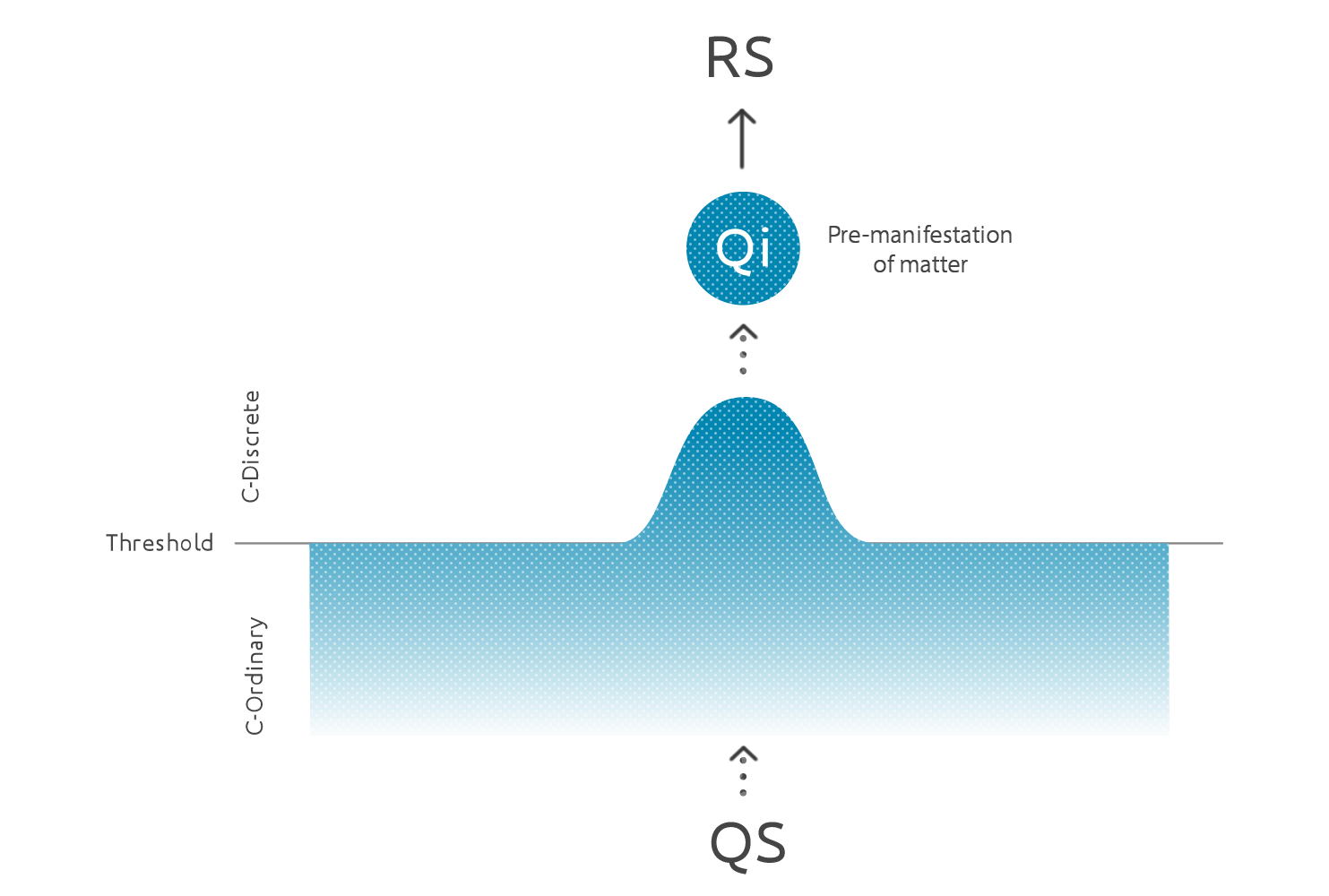
For anything to emerge from QS into RS it must pass through a coherence threshold:
\[ QS \rightarrow Qi \rightarrow RS \]
Qi acts as the discrete selection boundary.
Qi is not a particle, field, or medium.
It is the first discrete event that emerges from coherence when QS approaches resolvability.
Qi is:
\[ Qi = Discrete\ Coherence\ Selection\ Operator \]
It is an event of admissibility, not transport.
Qi performs one fundamental function:
It converts coherent potential into discrete permission.
Before Qi → only continuous coherence (QS)
After Qi → possible localized states (RS)
Qi is therefore the gate of existence.
Qi does not travel.
It acts like a collapse of compatibility across coherence:
\[ Qi(\Phi) \Rightarrow Allowed\ Discrete\ State \]
Where Φ is a coherence configuration emerging from QS.
No time delay occurs here because time does not yet exist.
Qi does not create matter.
It creates:
Qi is the moment where “can exist” becomes “eligible to exist”.
Superposition is native to QS, but RS can only host it after Qi defines the allowed discrete branches.
Thus:
\[ SP_{RS} = Projection(QS) filtered\ by\ Qi \]
Qi is the selector that constrains infinite coherence into finite possibilities.
Qi behaves like:
It is comparable (conceptually) to a Planck boundary, but not physical — purely coherence-based.
Qi is liminal.
It exists only during transition.
It has:
Qi is a coherence decision layer.
All discrete constants, quantization, and allowable particle states originate from Qi filtering.
RS inherits its rules from Qi.
Resonant Space (RS) is the domain where coherence becomes:
RS is not an independent container — it is coherence resolved under discrete compatibility.
\[ RS = Discretized\ Coherence\ Domain \]
Only after Qi filtering can RS appear.
RS introduces:
RS is the domain of physical observability.
RS behaves like a resonator where coherence can stabilize into standing configurations.
Matter is not inserted into RS — it is a stable resonance inside RS.
\[ Matter = Stable\ Resonant\ Lock\ in\ RS \]
RS operates under coherence thresholds:
RS therefore contains both:
Spatial dimensions appear only in RS.
Geometry is the result of coherence stabilization patterns.
Distance is not separation — it is coherence mismatch.
\[ Distance \sim \Delta(Coherence\ Alignment) \]
All physical fields are manifestations of coherence gradients:
RS is the field-expressive layer of coherence.
RS cannot exist without temporal discretization (COFT).
Without Time → no oscillation.
Without oscillation → no resonance.
Without resonance → no RS.
Thus:
\[ RS \leftrightarrow COFT \]
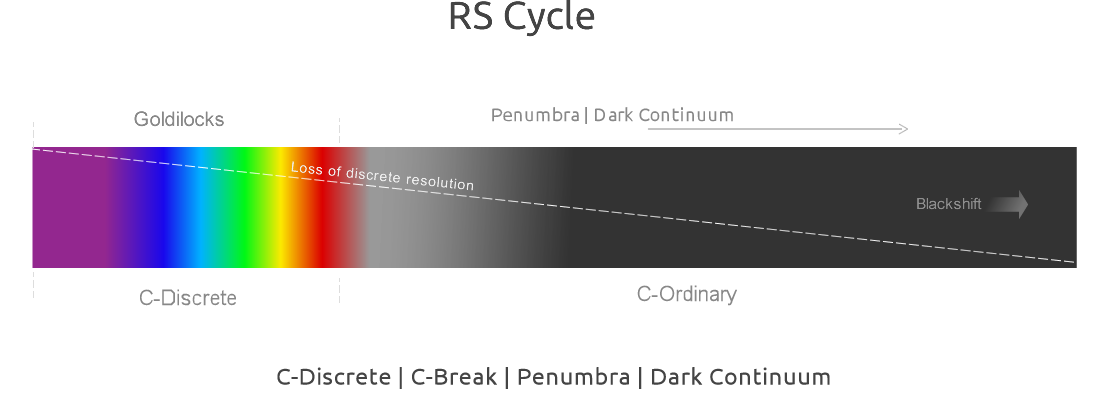
RS appears and disappears depending on coherence regimes.
When coherence loses discrete resolvability globally → RS collapses into dark ordinal states.
RS is therefore a temporary readable window inside GC.
Standard physics assumes RS as the base reality.
GC reverses this:
RS is not fundamental — it is emergent.
In GC, matter is not a fundamental “thing”.
Matter is a stabilized resonant configuration of coherence inside RS.
\[ Matter = Phase\text{-}Locked\ Coherence\ in\ RS \]
It exists only while coherence remains discretely compatible.
Pipeline: COH → QS → Qi → COFT → RS → Matter
Matter emerges when a coherence pattern:
Particles are not solid units — they are standing coherence nodes.
Like harmonics on a string:
\[ Particle_i \sim (f_i,\ \phi_i,\ A_i) \]
Atoms are coupled resonant systems of phase-locked particles.
Molecules are higher-order coherence locks.
Matter is therefore hierarchical resonance.
Matter survives only within C-Discrete regimes.
When coherence shifts beyond compatibility:
Mass is not intrinsic weight.
Mass measures resistance to coherence displacement.
\[ Mass \sim Stability\ Depth\ in\ RS \]
Greater lock → greater inertia.
Matter is a transient readable phase.
It is born when coherence locks.
It disappears when coherence unlocks.
No annihilation — only de-resolution.
Decay = loss of phase synchronization.
Particles do not “die” — they lose resonant stability.
Matter appears solid because:
Without coherence lock → matter vanishes.
Collapse as a compatibility function. In PoC, collapse is not a sudden or destructive event, but a smooth transition governed by coherence compatibility. Discrete manifestation emerges only when compatibility conditions (Qi) are satisfied, allowing phase-locked coherence to stabilize as matter. Below this threshold, coherence remains ordinal and non-discrete.
Coherence itself never breaks.
What breaks is the capacity of RS to resolve coherence discretely.
This defines the fundamental boundary:
\[ C\text{-}Discrete \longleftrightarrow C\text{-}Break \longrightarrow C\text{-}Ordinary \]
Zone where coherence is:
All known physics operates here.
Not a region, but a transition threshold.
At this limit:
No destruction occurs — only loss of discrete readability.
Beyond the coherence limit of matter.
Coherence still exists, but:
This domain sustains:
The coherence threshold is a compatibility boundary:
\[ Resolution\ Condition:\quad \Gamma_{COH} \geq \Gamma_{RS}^{min} \]
Below that threshold → coherence cannot stabilize as matter.
C-Break is the moment when:
Matter fades into ordinal coherence.
Entire universes drift toward C-Break as RS loses coherence resolution capacity.
This drives:
GC does not describe death of matter.
It describes transition of coherence between regimes.
Matter ⇄ Penumbra ⇄ Dark Continuum
Within the Grand Containment, space is not an empty stage where matter exists.
Space is:
\[ Space = Resolved\ Coherence\ Configuration \]
It emerges only when coherence becomes discretized inside RS.
Quantum Space (QS) contains coherence without geometry.
Only when coherence crosses the Qi threshold and stabilizes does space appear.
Thus:
\[ QS \rightarrow (Qi) \rightarrow RS \Rightarrow Space \]
Space is a consequence, not a precondition.
What appears as spatial extension is actually:
In GC terms:
\[ Geometry = Spatialized Coherence \]
Curvature is not caused by mass.
Mass is only a local coherence concentration.
Space bends because coherence density varies:
\[ Curvature \propto \nabla(COH\ resolution) \]
Which links directly to GRF later.
Regions of high coherence resolution produce:
Low coherence resolution produces:
Distance is not separation.
It measures how much coherence transformation is needed to connect two states:
\[ d \sim \Delta(Coherence\ Configuration) \]
Space is relational coherence, not metric emptiness.
As RS evolves:
Expansion = coherence dilution, not objects flying apart.
Space exists only where coherence is resolved discretely.
Beyond that, only ordinal coherence remains (no geometry).
Within the GC framework, time is not an independent continuum.
It is the observable result of coherence being discretized inside Resonant Space (RS).
Time = Discretized Interval under Coherence Stabilization

Time emerges only where coherence becomes phase-locked and measurable.
Before discretization, coherence exists as pure Interval in Quantum Space (QS):
The Interval is not time — it is the condition that allows time to be resolved.
\[ Interval_{QS} \xrightarrow{Qi} Interval_{locked} \rightarrow Time_{RS} \]
Time appears in RS through the COFT mechanism:
$$ \mathrm{COH} + \mathrm{Interval} + \mathrm{CEMF} \;\longrightarrow\;$$ Discretization → COFT
COFT acts as the spectral regulator that converts coherence intervals into temporal order.
It does not create events.
It enables their sequential manifestation.
Time corresponds to the rate at which coherence configurations stabilize into discrete states.
$\mathrm t \;\propto\; \mathrm{Rate}\bigl(\mathrm{Coherence\ Resolution}\bigr)$
Faster stabilization → denser temporal perception
Slower stabilization → temporal dilation
Each RS region operates with its own COFT scale depending on coherence density and spectral regime.
There is no universal clock — only locally resolved coherence timing.
The arrow of time reflects coherence ordering toward stabilization and dissipation within RS.
Time direction = coherence asymmetry during resolution.
Because RS itself is cyclic:
Time collapses when RS collapses back into QS.
Quantum Space contains no temporal metric.
Time is strictly an RS phenomenon.
COFT behaves like a spectral clock:
It measures coherence stabilization, not physical motion.
Within the GC framework, matter is not treated as a primitive entity.
It is a stabilized configuration of coherence resolved inside Resonant Space (RS).
$\mathrm{Matter} \;=\; \mathrm{Phase\text{-}Locked\ Coherence\ in\ RS}$
Matter is therefore an emergent state, not an ontological base.
All particles originate as coherent potential in QS, become encoded through Qi, and stabilize only when compatible with the discrete regime of RS.
$\mathrm{COH}_{\mathrm{QS}} \;\rightarrow\; \mathrm{Qi} \;\rightarrow\; \mathrm{RS}_{\mathrm{discrete}} \;\rightarrow\; \mathrm{Particle}$
Particles are resolutions of coherence, not transported objects.
A particle corresponds to a local equilibrium point of resonant coherence.
$\mathrm{Particle} \;=\; \mathrm{Local\ Resonant\ Equilibrium}(\mathrm{COH})$
This replaces the classical idea of solid entities with coherent stability nodes.
Mass reflects the degree of coherence locked into a stable discrete configuration.
$m \;\propto\; \mathrm{COH}_{\mathrm{locked}}$
Higher coherence stabilization → greater inertial persistence.
Atoms are closed resonant systems defined by permitted coherence states.
No mechanical orbit is required — only phase compatibility.
Matter exists exclusively inside the C-Discrete band of RS.
Beyond coherence thresholds:
Matter does not vanish — it becomes unreadable.
Discrete matter represents only a minor fraction of universal coherence.
$\mathrm{Discrete\ Matter} \;\ll\; \mathrm{Ordinal\ Coherence}$
Matter is a transient readable phase of RS.
Loss of coherence stabilization leads to:
This reframes collapse as coherence release rather than destruction.
Particles never traverse QS physically.
Only coherence configurations propagate, later resolving again within RS when compatible.
GRF — Gravity as a gradient of coherence. In PoC, gravity is described as a gradient in resolved coherence within RS, not as a force sourced by mass. Stable structures follow coherence gradients, forming geodesic tendencies rather than force-driven trajectories.
In GC, gravity is not produced by mass.
Gravity is the macroscopic effect that appears when coherence resolves unevenly across RS.
$\mathrm{Gravity} \;\equiv\; \nabla\bigl(\mathrm{Resolved\ Coherence}\bigr)$
No particles generate gravity.
Coherence gradients generate geometry, and geometry generates motion.
General Relativity describes curvature of spacetime.
GC reframes curvature as coherence-density gradients inside RS.
$\mathrm{GRF} \;=\;$ Spatial variation of coherence stability
Matter follows coherence valleys, not curved spacetime.
Two bodies appear to attract because:
$a \;\propto\; -\,\nabla C(x) $
where:
$ C(x) = resolved\ coherence\ density. $Gravity cannot exist outside RS because QS has no discretization and no geometry.
Without resolved coherence → no gradient → no gravity.
Penumbra domains influence motion because coherence gradients persist even when matter disappears.
This explains gravitational scaffolding without baryonic matter.
Free fall occurs because all structures move along the same coherence gradients.
Not because inertial mass = gravitational mass,
but because coherence resolution governs both.
Gravity is not mediated. It is the emergent geometry of coherence gradients in RS.
$\mathrm{Trajectory} \;=\; \mathrm{Geodesic\ in\ coherence\ landscape}$
Near coherence saturation:
Black holes become coherence sinks, not singularities.
Gravity is simply coherence trying to equalize its resolved density.
It is a stabilization law of RS.
GC is not introduced as speculative cosmology only.
Its structure suggests measurable deviations and potential technological pathways derived from coherence-based physics.
This block remains strictly grounded in observable consequences and testable directions.
All instruments operating in RS measure resolved coherence states, not intrinsic objects.
$\mathrm{Measurement} \;=\; \mathrm{Local\ coherence\ sampling}$
Thus, experimental uncertainty arises from coherence instability, not observational limitation alone.
GC predicts that near coherence thresholds (Penumbra regions):
Potential instrument category:
Coherence Gradient Sensors (CGS)
Devices designed to detect micro-variations in coherence stability before classical signals emerge.
Traditional interferometry measures wave overlap.
GC implies deeper layers:
$\mathrm{Interference} \;=\; \mathrm{Phase\ agreement\ of\ coherence\ projections}$
Predicted experimental extensions:
If energy transport follows coherence efficiency rather than amplitude only, systems could minimize loss by maintaining phase-aligned propagation.
$\mathrm{Efficiency} \;\propto\; \mathrm{Coherence\ stability}$
This directly motivates:
(Foundation for future integration with IROS / QRL / resonant computation.)
Dark Matter and Dark Energy effects become indirect measurements of unresolved coherence.
Thus GC suggests:
Standard simulations track particles and fields.
GC simulations must track coherence density evolution.
$\mathrm{RS}(x,t) \;=\; f\bigl(\mathrm{Coh}(x,t)\bigr)$
Matter becomes a derived layer, not the primary variable.
GC can be challenged if:
GC opens pathways toward:
Not engineering claims yet — but physically motivated directions.
GC is proposed as a physical meta-framework, not a philosophical construct.
Therefore, it must remain open to empirical testing, internal consistency checks, and potential falsification.
This block defines how GC can be scientifically challenged.
GC asserts:
$\mathrm{All\ observable\ phenomena} \;=\; \mathrm{Resolved\ coherence\ states\ in\ RS}$
Thus GC is falsifiable wherever coherence-based predictions diverge from measurement.
A theory that cannot be experimentally challenged is excluded from physics.
GC must be tested in areas where current physics already exhibits unresolved behavior:
These are not chosen arbitrarily — they are known fracture points in ΛCDM + QM.
GC predicts that gravitational effects follow coherence density gradients rather than mass alone:
$\mathrm{GRF} \;\equiv\; \nabla\,\mathrm{Coh}$
Falsification occurs if:
GC predicts transitional regimes where coherence partially locks but does not form stable particles.
Observable signature candidates:
Failure to detect transitional coherence regimes weakens GC.
GC reframes collapse as a coherence decision function:
$\mathrm{Collapse} \;=\; \mathrm{Threshold}\bigl(\mathrm{Coh\ compatibility}\bigr)$
Experiments involving weak measurement and delayed choice become critical tests.
If collapse remains strictly observer-dependent with no structural coherence basis → GC fails.
GC predicts that:
Observational threats to GC would include:
Although GC is cosmological, it implies micro-scale consequences:
These may be probed via:
GC stands under three conditions:
$\mathrm{If\ predictions\ fail} \;\Rightarrow\; \mathrm{GC\ must\ be\ revised\ or\ rejected}$
This is a scientific framework, not belief.
GC does not ask to replace physics.
It asks to be tested where physics is already incomplete.
If coherence is not the underlying structuring principle — experiments will show it.
If coherence governs RS manifestation — GC becomes inevitable.